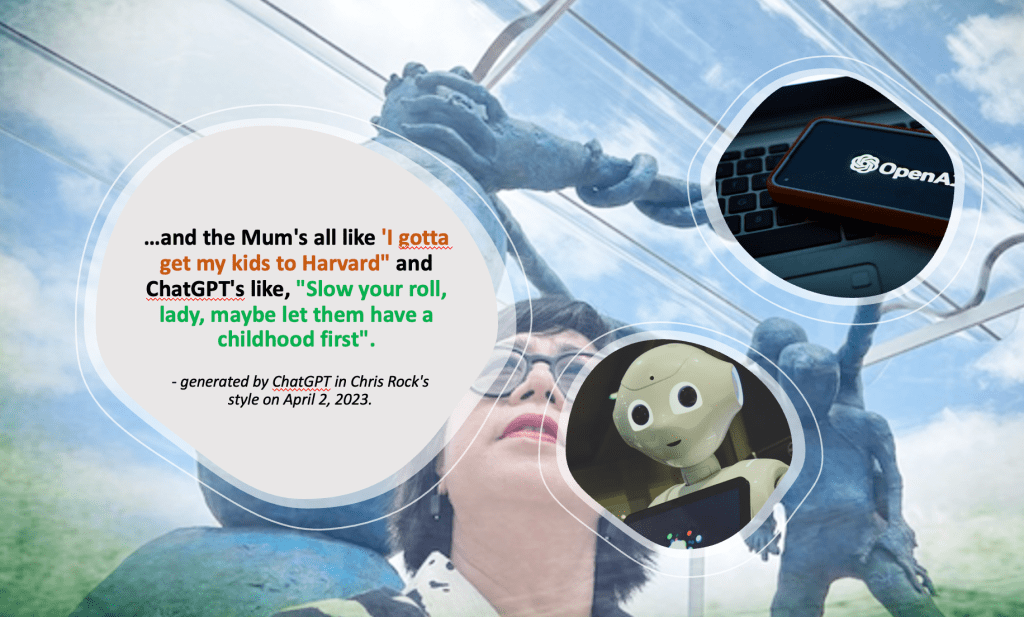
So, what’s all this fuss about ChatGPT?
12 months ago, no one really knew or cared about ChatGPT as it was still in the ‘hunting and gathering’ stage when Sam Altman et al. were still building corpus ‘language’ for this AI chatbot in their lab at OpenAI head office in San Francisco. The world was still busy debating whether we should have the 5th Covid jab or let herd immunisation run their course. Came November 30th, 2022! Chat Generative Pre-Trained Transformer aka ChatGPT screamed hello to the world, officially. And ‘everything, everywhere, all at once’ we wowed about, fussed about and then worried about it. This intelligent chatbot, which is built on machine learning technology with the purpose of helping humans with automated chat tasks is the next level of artificial intelligent capacity (Arimetrics, 2022). It is the ‘fasted-growing consumer application in history’ (Hu, 2023, p1) drawing a whooping 100 million active users within 2 moths from its launch date. To put this phenomenon into perspective, the ever-popular video platform Tiktok only reached this many users 9 months from its induction, and the well famed platform Instagram 2 years and a half (Similarweb, 2022 as cited in The Time, 2023).
Chatbot technology is not totally new or innovative within the ever-growing AI realm where you might have also heard of Jasper Chat, Chatsonic, YouChat, Microsoft’s Bing, Google Bard AI. But ChatGPT seems to trump them all in terms of popularity, friendly-user-ness, and efficiency. Additionally, it is the very first AI project to invite the public to ‘use, play with, and break’ for free (Chow, 2023). If you are more serious and would like to enjoy supersonic fast response rate with priority access to new features and improvements from this AI platform, you can pay $20 a month for the latest ChatGPT Plus version, which became available mid-February, 2023.
Known as a generative AI, it responds to virtually any tasks you type in its conversation box: from describing a puppy to writing you a polished CV for job application; from writing a script to produce an episode of ‘Alone Sydney’ documentary to advising what language is more appropriate to talk to teenagers…and it does it at a lightning speed. In fact, I have just asked ChatGPT the latter task and I was surprisingly happy with the response. That brings me to write the next part where I explain how this AI chatbot has influenced me as a mother within 24 hours.
Talking about mothers, why Tiger mum?
On the historic day of March 13, 2023, as soon as her name was called the winner of the prestigious Oscar’s best actress award, Michelle Yeoh credited her success to her beloved mum in her acceptance speech, thanking “all the mums in the world because they are really the superheroes and without them none of us would be here tonight.”. Ke Huy Quan then teared up calling out ‘Mum, I just won an Oscar’ as he held up the one-in-a-life-time-of-the-whole-Vietnamese- or Chinese-American supporting acting gold statue. Then ‘everything, everywhere, all at once’, people talked about their mums, Asian mums to be more specific. Then I think about my beloved ‘Tiger mum’, who insisted I should study for a doctor degree knowing too well her only daughter would faint at the sight of blood :-). Yep, I have a Tiger mum, whom I love dearly and started to appreciate her more now that I am a mum, not a Tiger one though (I would think of me as a Kangaroo mum somehow, wink!). I know most Asian or Asian-Australian mums would know or feel somehow related.
So, the Tiger mum?
Well 12 years ago, no parents really cared about the specific type of parenting they had been practising on their children or what label should they have had pasted on their daily endeavours with their children. Came 2011, every parent in the US, every parent elsewhere wowed about, talked about, fussed about and then worried about whether they were ‘Tiger parents’ having read the then best-selling memoir of Professor Amy Chua of Yale University. It was very much a case of ‘now you see me, now you don’t’ in terms of parenting labelling in the good old day until ‘Tiger mum’ became such a big thing.
Asian Tiger mums’ priority lies in education and their children’s educational achievements, solemnly. Any other children’s life aspects or activities which are not for education success are void or deserve minimal to zero attention. They dedicate their life to their children well-being and studying and do so with such sense of pride and command. They would feel quietly proud whenever the kids come home announcing they come first at maths at school that term or disastrously devastated if the kids don’t like learning or are happier playing computer games or going to friends’ parties. Tiger mums are only ‘interested in academic results…hence they only turn up to meetings about exams at their children’s school’ (Ho, 2020, p.101) because they do not view non-academic activities as meaningful or useful for their children therefore, they see no reason to participate into any other aspects of their children’s schooling or life (Ho, 2020, p.101). Ah and NO SLEEPOVERS, full stop! Because I say so, come the explanation!
Another aspect of Tiger mum is the Confucius influence in believing that if you care for someone, you DO things for them, not TALK. The children we care for are supposed to ‘bring fame, not shame’ to the family. My own Tiger mum would emphasise this by even amplifying that TALKING to me or telling me ‘I love you’ is non-sensical. So, when Asian mums migrate to Australia, for examples, it is a big challenge to compromise their mothering belief and their communication with their Australian-born kids. They DON’T believe that saying ‘I love you’ every hour will get their kids to USYD or UNSW in the future, they DO believe in taking them to Kumon tutors on weekends and homework intensity after school hours, though. They DON’T ask ‘How’s the Zoo excursion?’ or ‘Do you like to go see the Sydney Swans playing this weekend at the SCG?’, they DO say ‘Have you done your extension math tasks?’ or ‘Do you like to collect rubbish as a job or earn good money being a lawyer? – Do your homework, NOW’.
Somewhere in between, there are Asian mums like me, who have this trait of ‘Tiger mum’ in our blood as a result of being raised by Tiger one’s ourselves, who not only DO everything to make sure our kids stay healthy and motivated but also wish to be able to TALK to our kids effectively or simply be able to say ‘I love you’ in their relatable ways. And if you know Asians, you know it’s not easy at all to say that simple sentence (Chung, 2014).
How ChatGPT helps a Tiger mum
Today, my universe suddenly witnesses the union of two of the above ‘trendy’ characters. (Drum roll, please!). It feels like ‘when Harry met Sally’ kind of vibe :-). ChatGPT and a Tiger mum walk into my Zoom meet. Tiger mum asks and ChatGPT responds. Here is exactly what goes down:
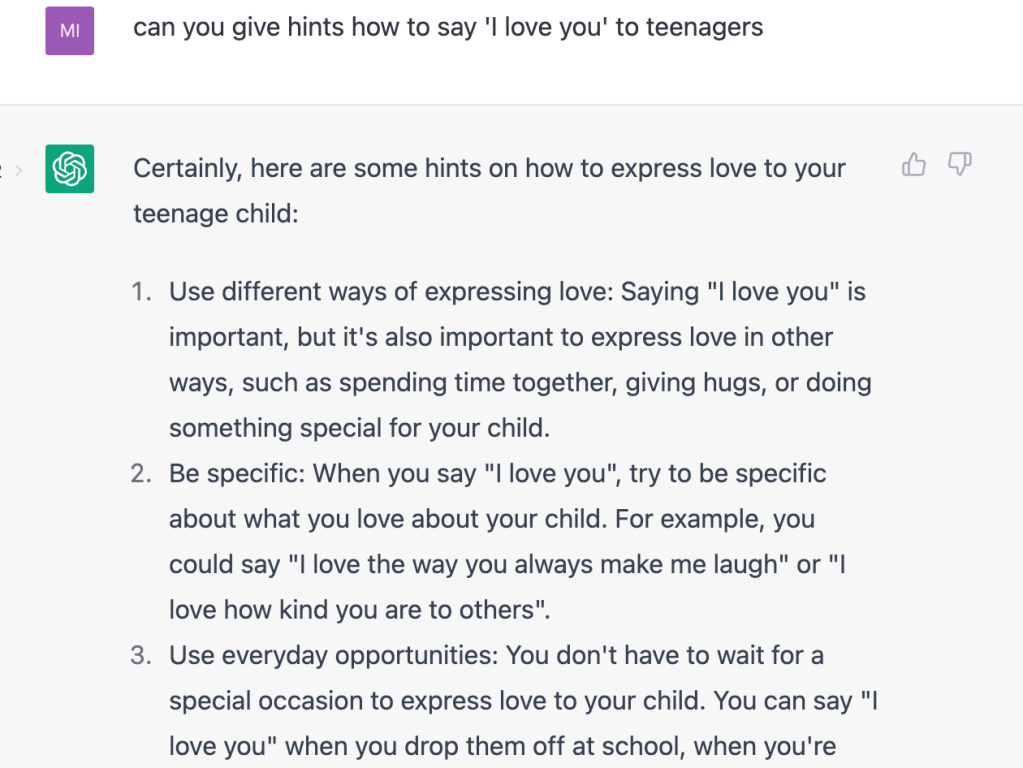
et Voila!
To be honest there’s a lot I learn from ChatGPT in such a short time, it’s like my junior personal assistant (PA), who has so much good knowledge but sometimes this PA is misleading and temperament as f… (Haha, now I use my teenager’s language). By the way if you haven’t watched Lexi the movie, go Netflix it now, it’s quite funny and relatable.
OK let’s sum this up. There is no ‘best mum’ in the whole wide world. Maybe, and it is a big MAYBE, they only exist in Mother’s Day mugs and present tags and beautiful cards. But for those, including myself, who are doing one of the most difficult gigs in the world (we earn this bragging right, trust me!), employing the help of the most talked-about AI tools like this ChatGPT ‘guy’ maybe not a bad idea, may it not?

Minnie Fabiansson
References:
Chow, A. (2023, February 8). How ChatGPT Managed to Grow Faster Than TikTok or Instagram. Time. https://time.com/6253615/chatgpt-fastest-growing/
Chung, C. (2014, March 4). Why Chinese Parents Don’t Say I Love You. The Sydney Morning Herald. https://www.smh.com.au/lifestyle/life-and-relationships/why-chinese-parents-dont-say-i-love-you-20140304-341ws.html
Ho, C. (2020). Aspiration and Anxiety: Asian Migrants and Australian Schooling. Melbourne University Publishing.
Hu, K. (2023, February 2). ChatGPT Sets Record for Fastest-Growing User Base – Analyst Note. Reuters. https://www.reuters.com/technology/chatgpt-sets-record-fastest-growing-user-base-analyst-note-2023-02-01/
What Is ChatGPT | Definition, Functionalities and Limitations. (2022, November 21). Arimetrics. https://www.arimetrics.com/en/digital-glossary/chatgpt

 From mums' Chats to teachers' talks - everything everywhere everyone...but not all at once!